CAGIS Researcher Publishes New Study on Malaria Gene Flow Mapping
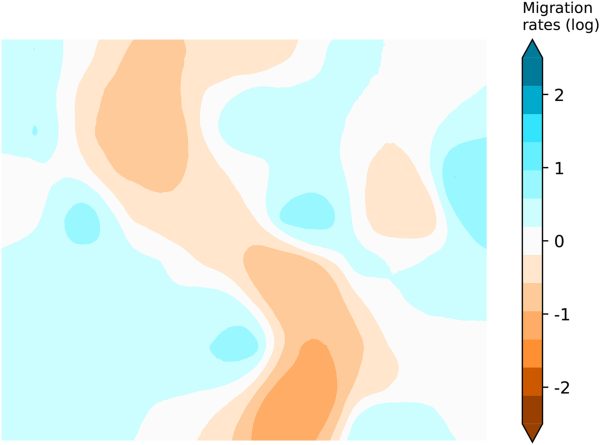
We are pleased to highlight a new publication by Dr. Yao Li, Associate Director of Research at CAGIS, and collaborators in Molecular Ecology Resources: “Improving Malaria Parasite Gene Flow Inference Under Sparse Spatial Sampling.”
Understanding how malaria parasites move between places is important for identifying potential transmission sources, migration corridors, and areas where interventions may have the greatest impact. Genetic data can help reveal these spatial patterns, but when samples are collected from only a limited or uneven set of locations, the resulting maps may contain misleading features.
In this study, the researchers developed a sample location–aware (SLA) filtering approach that explicitly considers how well different geographic areas are represented by sampling locations. By combining spatial techniques including kernel density estimation with genomic migration modeling, the method helps distinguish more reliable spatial patterns from features that may result from sparse sampling.
Tests using simulated genomic data showed that the new approach improved the precision of inferred low-migration areas. A case study using Plasmodium falciparum data from Cambodia also produced more stable estimates of parasite migration patterns when sampling locations were reduced.
This work demonstrates how spatial analysis and population genomics can be integrated to improve the reliability of disease-migration mapping, providing a useful methodological framework for malaria research and other studies that rely on geographically sampled genetic data.
Congratulations to Dr. Li and the research team on this publication!